

Under Pressure
By Alex Johnson | 07 April 2026 | 5 minute read
Key findings:
- 83bps — average ongoing advice fee in 2026 (up from 77bps in 2025)
- 23% of advisers raised their ongoing fee in the past 12 months
- 45% of clients say their advice fees increased in the past year (up from 38% in 2025)
Advice fees are climbing. Our latest Fee Benchmarking Report, based on surveys of 545 UK financial advisers and 261 advice clients, shows the average ongoing advice fee has risen to 83 basis points while the average total cost (including fees and platform) is 180bps – the same as in 2025. That’s up from 77bps a year earlier. Nearly one in four advisers increased their ongoing fee in the past 12 months, and a further 17% plan to do so in the year ahead.
The data: who’s raising, who’s cutting
Our 2026 report breaks out fee changes across all five components of the advice cost chain. The pattern is clear: advice fees (both initial and ongoing) are set to continue and if firms want to keep the total cost down then there is increased pressure on fund and platform fees.
Figure 1: Change in fees charged by financial advisers in the past 12/next 12 months
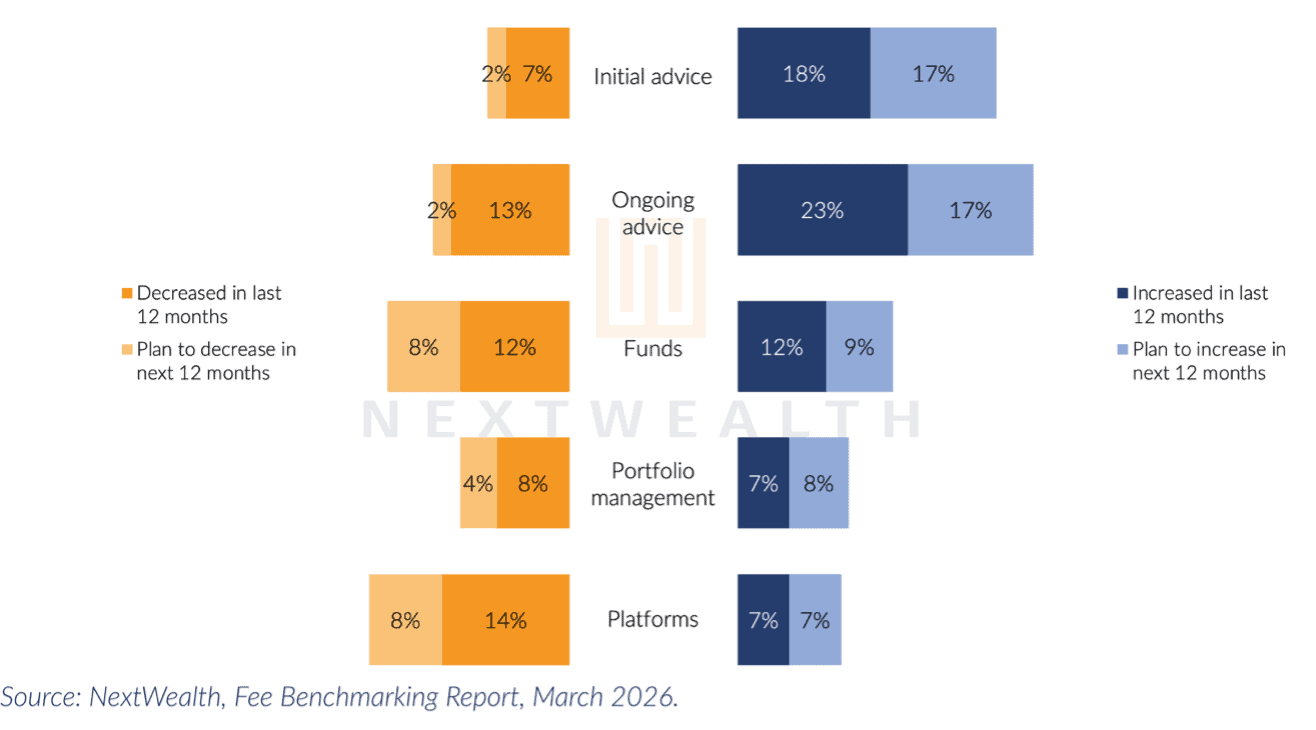
Q: Has your firm made any changes to the fees it charges over the last 12 months?/Does your firm expect to make any changes to the fees it charges over the next 12 months? (Increase/Decrease)
Three things the chart tells us
- Ongoing advice fees continue to rise. 23% of advisers raised their ongoing fee in the past year and 17% plan to again.
- Fund fees are plateauing. Roughly equal proportions of advisers report fund fee increases (12%) and decreases (8%) over the past year, and the forward-looking picture is similarly balanced (9% expect increases, 12% decreases).
- Platform fees face downward pressure. Platform fees raised 3bps this year. However twice as many advisers expect platform costs to fall (14%) as expect them to rise (7%) over the next 12 months.
The bigger picture: 18 months of rising costs
Our data doesn’t exist in a vacuum. The upward drift in advice fees has been building for some time, driven by a combination of regulatory cost, operational pressure and structural change across the industry.
The largest firm by assets and clients, St. James’ Place, moved from a flat 4.5% initial advice charge to a tiered model: 3% on the first £250,000, 2% on the next £250,000, and 1% above £500,000. Ongoing adviser charges were set at around 0.8%.
Other firms have been reshaping their models too – specifically consolidators (more on this in our 2026 Consolidation of Advice Report publishing over the coming weeks) Ascot Lloyd introduced a tiered ongoing fee structure in February 2025 as part of a wider rebrand, ranging from 1% on portfolios up to £250,000 down to 0.65% above £2 million. Shackleton, meanwhile, went the other way on product costs – cutting platform fees and OCFs for clients using its in-house investment service, and charging a 25bps lower advice fee for that proposition.
On the topic of AI: enhancing not cutting
Advisers do not believe that AI usage will cut the cost of advice. Over half of advisers (51%) agree that AI will allow them to provide more value for the same fees. But only 19% believe it will enable them to reduce fees in the future and just 9% say AI has already led to a fee reduction.
Figure 2: Adviser view on the impact of AI on fees
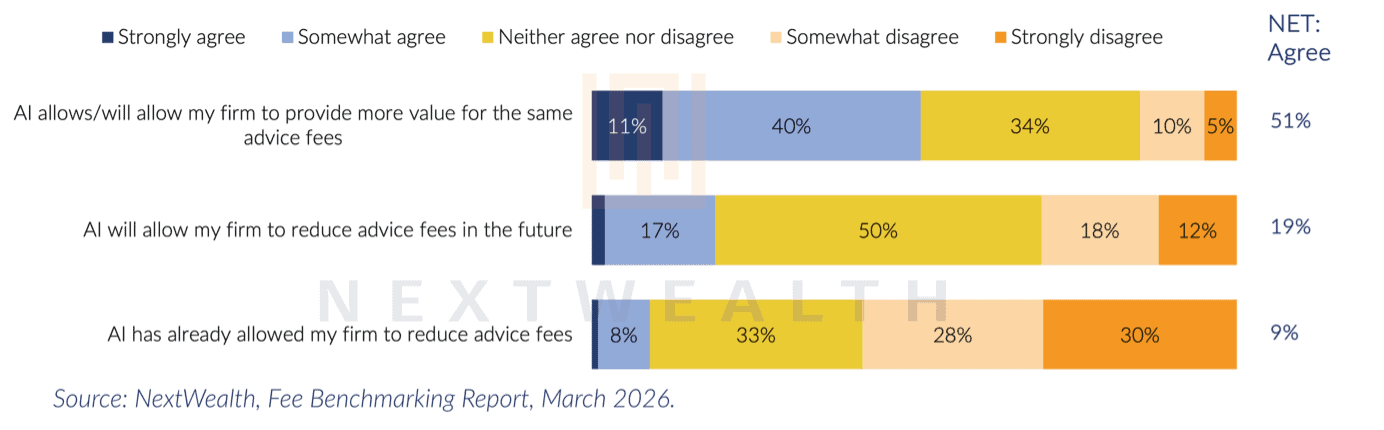
Q: To what extent do you agree with the following statements regarding the fees you charge?
The message from the data is clear: advisers see AI as a tool to enhance the quality, consistency and scalability of their service – not to discount it. From our Adviser Tech Stack series report, Clearing the path for AI in advice, we heard that AI is improving monitoring, analysis, documentation and communication processes, freeing up adviser time, but that efficiency gain is being reinvested into the proposition, not passed on as a fee cut.
The bottom line
Advice fees are going up. Fund and platform fees are under pressure if firms aim to keep their total cost at 180bps. Firms across the market are actively restructuring how they charge – driven by rising regulatory costs, the operational weight of Consumer Duty compliance, and growing client demand for transparency. And while AI is reshaping how advice is delivered, advisers are clear it won’t be used to cut fees; it’s being deployed to enhance the value of the service they provide.
Get the full report
The NextWealth Fee Benchmarking Report 2026 covers initial and ongoing advice fees, fund and platform costs, pricing models, client perceptions of value, and the impact of AI on advice. Based on surveys of 545 advisers and 261 clients.
FAQs
1. What is the average financial advice fee in the UK in 2026? The average ongoing financial advice fee in the UK is 83 basis points (0.83%) in 2026, up from 77bps in 2025, according to the NextWealth Fee Benchmarking Report 2026, based on surveys of 545 UK financial advisers.
2.What is the average total cost of financial advice in the UK in 2026? The average total cost of financial advice — including advice, fund, and platform fees — is 180 basis points (1.80%) in 2026, unchanged from 2025, despite the rise in ongoing advice fees.
3. Are financial advice fees increasing in 2026? Yes. Nearly one in four UK financial advisers (23%) raised their ongoing advice fee in the past 12 months, and a further 17% plan to increase fees over the next year, according to NextWealth’s 2026 Fee Benchmarking Report.
4. Why are financial advice fees rising in the UK? Financial advice fees are rising due to a combination of increased regulatory compliance costs, the operational burden of Consumer Duty requirements, and structural changes across the advice industry, including consolidation and service model redesigns.
5. Will AI reduce the cost of financial advice? Unlikely in the near term. Only 19% of UK financial advisers believe AI will enable them to reduce fees in the future, and just 9% say AI has already led to a fee reduction. The majority (51%) see AI as a way to provide more value for the same fees, not as a tool to discount their services.