

The FABB Future Five: what advice firms should be thinking about next
By Alex Johnson | 22 September 2026 | 6 minute read
Apologies for the alliteration but hopefully it got your attention.
We recently published our 2026 Financial Advice Business Benchmarks report (download it for free), for which we asked 318 financial advice professionals about their firm and plans for the future. One key question in this year’s report was on the theme of growth. The answer from financial advice professionals is that growth is becoming more deliberate. Firms are adding clients and turning others off. They are investing in technology and re-examining what advice costs to deliver.
Five themes run through the data and look set to shape the next 12 months, which we have dubbed the FABB Future Five.
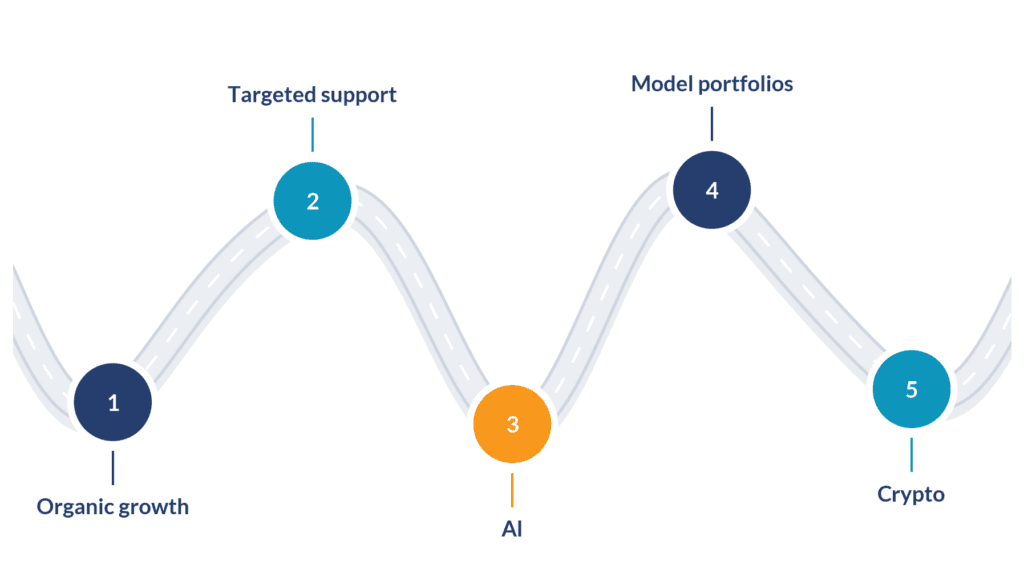
The FABB Future Five
- Organic growth on the horizon
Taking on new clients is the most common growth plan for the fourth year running. Nearly two thirds of advice professionals, 64%, are at firms planning to do it, and almost half, 49%, are already looking after more client relationships than they were a year ago. That is the highest share since 2021. What has changed is where those clients come from. Referrals from existing clients and family now account for 56% of new business, down from 67% in 2025, while marketing has jumped from 6% to 13%. Growth is becoming something firms go out and build rather than something that turns up.
- Targeted support is being talked about
Targeted support is on the agenda, if not yet on the shelf. Almost a quarter of firms, 23%, offer it or are considering it, and larger firms are furthest ahead. It is one of several routes firms are exploring to serve clients differently. A third, 34%, offer, are developing or refer clients to a digital or lower-touch proposition, and 37% offer or are developing a simplified advice service. With 40% having reviewed what it costs to serve a typical client, the question they are wrestling with is, which clients need a full ongoing service and which can be looked after another way.
- AI has arrived, but full automation is still a question
Almost half of advice professionals, 47%, are at firms already using AI, and another 13% are in the middle of implementing something. But look at what it is actually doing. Meeting notes and summaries are the leading use case, which is AI taking notes rather than AI running the process. Adopters are no longer a distinct breed either. They look much like the rest of the market, although they tend to be larger and are growing faster, with 69% planning to hire in the next year against 61% overall. At the other end of the scale, 20% of sole traders are neither using AI nor considering it.
- Model portfolios stay on the move upwards
Discretionary model portfolios have moved ahead of multi-asset and multi-manager funds for the first time in a three-year comparison of the strategies advisers use for new client money. Just over half, 52%, use model portfolios, against 51% for multi-asset or multi-manager. That is hardly a landslide, and half of advisers still use both. But the forward-looking data points the same way, with 32% expecting to increase their use of model portfolios and 31% expecting to use more multi-asset and multi-manager funds.
- Crypto is still a conundrum but under consideration
Crypto is finding its way into the fact find, slowly. Just over a quarter of advisers, 26%, ask every client about cryptocurrency or digital asset holdings, and another 14% ask some clients. More than two in five, 43%, only record it if the client brings it up, and 15% never ask at all. Advisers who hold crypto themselves, 21% of the total, are the most likely to ask. Whether or not a firm advises on digital assets, those holdings still affect a client’s wealth, risk exposure and tax position, which is a fair argument for knowing they are there.
Do advisers proactively ask clients about crypto holdings?
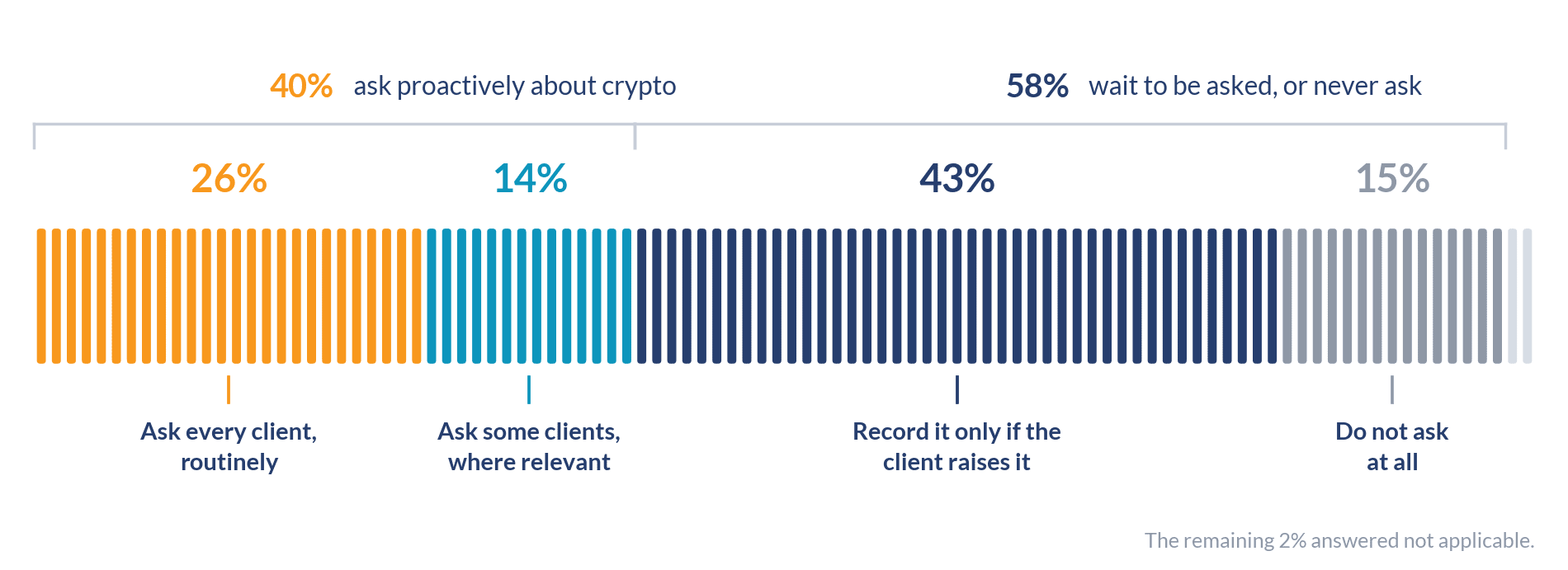
Source: NextWealth Financial Advice Business Benchmarks 2026. Base: 318 UK financial advice professionals, June 2026.
The thread running through all five is deliberate choice. Each one is a decision about who a firm serves, how it serves them and who does the work. The firms that make those decisions on purpose, rather than letting the client book make them by default, are the ones most likely to end up with a growth model that holds.
If you are interested in reading more, head over to download the full publication now.
FAQS:
What are the FABB Future Five?
The FABB Future Five are five themes from NextWealth’s Financial Advice Business Benchmarks 2026 that look set to shape UK financial advice over the next 12 months: organic growth through new clients, targeted support, AI adoption, the rise of discretionary model portfolios, and cryptocurrency entering the fact find. The report is based on a survey of 318 UK financial advice professionals carried out in June 2026.
What is the Financial Advice Business Benchmarks report?
The Financial Advice Business Benchmarks report, known as FABB, is NextWealth’s annual study of the UK financial advice market. The 2026 edition is the eighth and draws on a survey of 318 financial advice professionals conducted in June 2026. It covers client service, growth, people, technology, investment, fees and operating models.
How are UK financial advice firms planning to grow in 2026?
Taking on new clients is the most common plan. NextWealth’s Financial Advice Business Benchmarks 2026 found that 64% of advice professionals work at firms planning to grow by taking on new clients, 53% by increasing assets from existing clients and 15% through acquisition. Almost half, 49%, already look after more client relationships than they did a year ago.
How many financial advisers use AI?
Nearly half do. NextWealth’s Financial Advice Business Benchmarks 2026 found that 47% of UK financial advice professionals work at firms already using AI, with a further 13% implementing a solution. Meeting notes and summaries are the leading use case. Among sole traders, 20% are neither using AI nor considering it.
Do financial advisers ask clients about cryptocurrency?
Four in 10 ask proactively. NextWealth’s Financial Advice Business Benchmarks 2026 found that 26% of UK advisers routinely ask every client about cryptocurrency or digital asset holdings and 14% ask some clients. A further 43% record crypto only if the client raises it and 15% never ask. One in five advisers, 21%, personally hold crypto.
What is targeted support and how many advice firms offer it?
Targeted support lets firms suggest a course of action to groups of consumers who share common characteristics, without giving a personal recommendation. The FCA’s rules came into force on 6 April 2026. NextWealth’s Financial Advice Business Benchmarks 2026 found that 23% of UK advice firms offer or are considering targeted support, with larger firms furthest ahead.
Which investment solutions do advisers use for new client money?
Discretionary model portfolios now lead. NextWealth’s Financial Advice Business Benchmarks 2026 found that 52% of UK advisers use a discretionary model portfolio service for new client money, just ahead of multi-asset and multi-manager funds on 51%. It is the first time model portfolios have topped a three-year comparison, and 32% expect to increase their use over the next year.